Darlinghurst, NSW
By Lauren McCaleb · Reviewed by Dylan Duncan ·
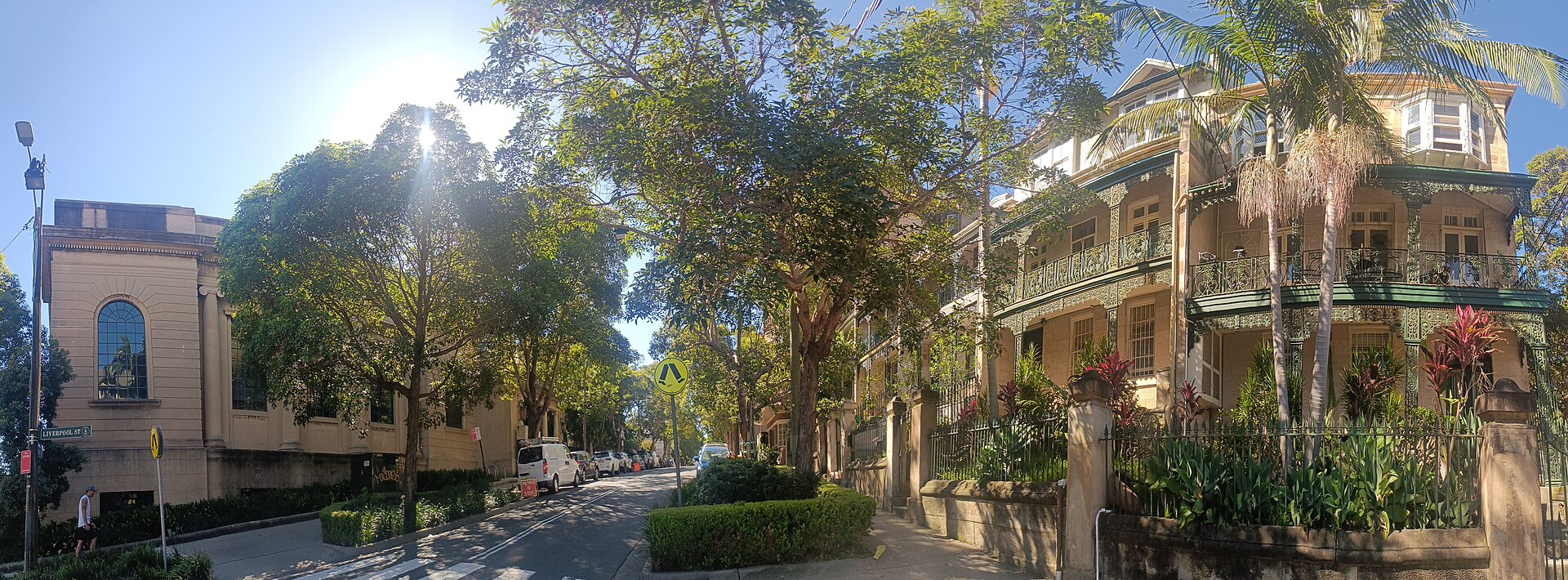
Darlinghurst is a dense inner-city suburb immediately east of Sydney's CBD, on the traditional country of the Gadigal people. It was named after Eliza Darling, wife of Governor Ralph Darling, with the old English ending '-hurst' meaning a wooded rise. Grand in colonial days, it slid through the twentieth century into a notorious slum and red-light district before renewal from the 1980s turned it around. Today Darlinghurst is one of the most vibrant parts of the city: a heartland of Sydney's LGBTQ+ community and the Mardi Gras parade, packed with small bars, cafés, restaurants and independent shops, and home to the National Art School in the old Darlinghurst Gaol.
Among Australia's more advantaged suburbs
Darlinghurst is more socio-economically advantaged than about 99% of the 14,462 Australian suburbs we score, based on the ABS SEIFA index (raw score 1155, where about 1000 is the national average).
A socio-economic measure from ABS Census data — not a measure of how good a suburb is to live in or visit. How we calculate this.
Is Darlinghurst a good place to live?
There’s no single answer — it depends on what matters to you. So instead of one mystery number, we break it down: a transparent score on each part of life we can back with public data, and an honest “not yet” on the parts we can’t.
Strong on the data we score
A weighted blend of the 2 components we can score for Darlinghurst from public data. It sits alongside — and reconciles with — the socio-economic Suburb Score above; it is a transparent read, not a complete verdict.
Socio-economic advantage
99/100Among Australia's more advantaged suburbs
Among Australia's more advantaged suburbs — the same ABS SEIFA-based Suburb Score (99/100) shown above. Income, education and occupation, as published by the ABS. · ABS SEIFA 2021
Housing affordability
4/100Among the more expensive suburbs
Median weekly rent was $550 at the 2021 Census — more affordable than about 4% of suburbs we can compare. Housing data only, no valuations. · ABS Census 2021
Not yet scored
We’d rather leave these open than publish a number we can’t stand behind. Here’s where each one stands.
- Amenities & accessNot scored yet — our OpenStreetMap amenity mapping is still rolling out across suburbs.
- Green spaceNot scored yet — our OpenStreetMap green-space mapping is still rolling out across suburbs.
- TransportNot scored yet — our OpenStreetMap public-transport mapping is still rolling out across suburbs.
- SchoolsNot scored yet — school performance (ACARA / ICSEA) needs a data-reuse licence cleared before we can publish it.
- SafetyNot scored yet — Australia has no single open crime dataset and safety data carries defamation and legal care, so it is gated pending a go/no-go and will be data-only when added.
- CommunityNot scored yet — we won't reduce community to a number from a proxy. We'd rather leave it open than publish an invented value judgement.
A transparent read on public data, not a verdict — and not a measure of any person or community. See our methodology for how each component is worked out and why some aren’t scored yet.
Darlinghurst at a glance
- Population (2021)
- 10,615
- Median age
- 37
- Median weekly household income
- $2,279
- SEIFA score
- 1155
- Local government area
- Sydney
- Coordinates
- -33.8794, 151.2190
Map of Darlinghurst
© OpenStreetMap contributors · View larger map
Housing & property in Darlinghurst
What it costs to live in Darlinghurst and how residents hold their homes, from the Australian Bureau of Statistics 2021 Census.
- Median rent
- $550
- per week
- Median mortgage
- $2,964
- per month
- Owner-occupied
- 36%
- of dwellings
- Rented
- 62%
- of dwellings
The full tenure and dwelling-type breakdown is in the Darlinghurst demographics section below.
Source: ABS Census of Population and Housing, 2021. © Australian Bureau of Statistics, released under CC BY 4.0. See our methodology.
Darlinghurst demographics (2021 Census)
The figures below profile Darlinghurst using the Australian Bureau of Statistics 2021 Census; every percentage is a share of a clearly stated Census count, so each one traces back to the source. At a glance, the largest age group is young adults (25–44) at 51% and 43% of residents were born overseas.
Age profile
| Age group | People | Share |
|---|---|---|
| Children (0–14) | 556 | 5% |
| Youth (15–24) | 861 | 8% |
| Young adults (25–44) | 5,387 | 51% |
| Mid-life (45–64) | 2,607 | 25% |
| Seniors (65+) | 1,195 | 11% |
Share of the 10,606 people counted by age.
Housing and households
| Tenure | Dwellings | Share |
|---|---|---|
| Owned outright | 907 | 17% |
| Owned with a mortgage | 1,038 | 19% |
| Rented | 3,332 | 62% |
| Dwelling type | Dwellings | Share |
|---|---|---|
| Houses | 48 | 1% |
| Townhouses & semis | 1,054 | 20% |
| Flats & apartments | 4,243 | 79% |
Tenure and dwelling shares are of the roughly 5,384 occupied private dwellings in Darlinghurst.
- Average household size
- 1.7 people
- Median weekly family income
- $3,913
- Median weekly personal income
- $1,535
Community and culture
- Born overseas
- 4,291 (43%)
- Speaks a language other than English at home
- 2,201 (22%)
- Aboriginal and/or Torres Strait Islander
- 97 (1%)
Work and education
- Completed Year 12
- 8,100 (81%)
- Labour-force participation
- 72.9%
- Unemployment rate
- 4.5%
- Employed full-time
- 4,864
- Employed part-time
- 1,537
Source: ABS Census of Population and Housing, 2021 (General Community Profile, by Suburb and Locality). © Australian Bureau of Statistics, released under CC BY 4.0. How we group bands and derive each share is set out on our methodology page.
Weather and climate in Darlinghurst
Based on 2014–2023 records, the warmest month in Darlinghurst is January (average daytime high around 26.6°C) and the coolest is July (around 17.2°C). The area receives roughly 902 mm of rain across the year.
| Month | Avg high | Avg low | Rain |
|---|---|---|---|
| Jan | 26.6°C | 19.6°C | 80 mm |
| Feb | 25.9°C | 19.2°C | 103 mm |
| Mar | 24.8°C | 18.2°C | 149 mm |
| Apr | 22.6°C | 14.8°C | 82 mm |
| May | 19.9°C | 11.4°C | 46 mm |
| Jun | 17.1°C | 9.5°C | 69 mm |
| Jul | 17.2°C | 8.1°C | 59 mm |
| Aug | 18°C | 8.6°C | 54 mm |
| Sep | 20.4°C | 10.7°C | 44 mm |
| Oct | 22.6°C | 13.6°C | 78 mm |
| Nov | 23.7°C | 15.5°C | 70 mm |
| Dec | 25.6°C | 17.7°C | 68 mm |
Climate normals, 2014–2023 (Open-Meteo, ERA5 reanalysis).
Share your local knowledge of Darlinghurst
Lived here or spent time in Darlinghurst? Add a review or a quick tip. Reviews and tips are moderated before they appear.
Common questions about Darlinghurst
Is Darlinghurst a good place to live?
There's no single answer, so we score what the public data can back. On socio-economic advantage and housing affordability, Darlinghurst rates 67/100 overall (Strong on the data we score). Public transport, schools and safety aren't scored yet — see our methodology for why.
What is the median rent in Darlinghurst?
At the 2021 Census, the median weekly rent in Darlinghurst was $550, and the median monthly mortgage repayment was $2,964. These are official ABS Census figures — StreetScout publishes housing data only, with no property valuations or agent referrals.
Where is Darlinghurst?
Darlinghurst is a suburb of New South Wales, Australia, in the Sydney local government area.
What is the population of Darlinghurst?
At the 2021 Census, Darlinghurst had a population of about 10,615.
Is Darlinghurst an advantaged area?
Darlinghurst has an ABS SEIFA score of 1155, where about 1000 is the national average — higher scores indicate greater relative socio-economic advantage. That gives it a Suburb Score of 99 out of 100 — more socio-economically advantaged than about 99% of Australian suburbs.
What is the weather like in Darlinghurst?
Darlinghurst has average daytime highs of about 22°C and overnight lows of about 13.9°C, with roughly 902 mm of rain across the year (based on 2014–2023 climate normals).
Nearby suburbs in New South Wales
More suburb guides in New South Wales
Other hand-written, cited guides — browse all guides.